
You’re Not Just Paying for the Waffle
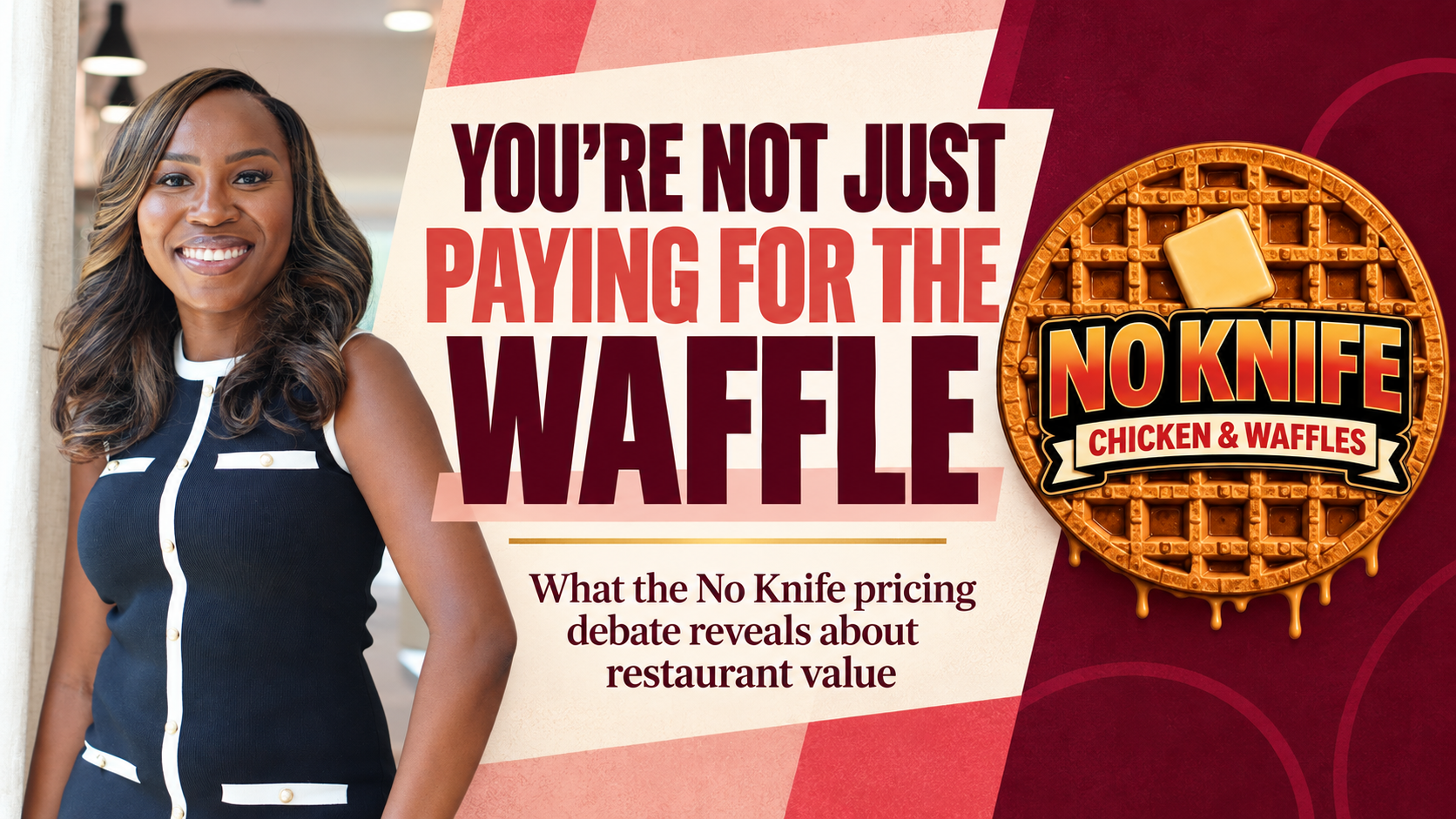
What the No Knife pricing debate reveals about restaurant economics, value, and the way we talk about food businesses
When I first started seeing the reactions to DaBaby’s No Knife Chicken & Waffles in Charlotte, I was honestly appalled and taken aback. Some of the reactions were visceral. As a food operator who works hard to bring high-quality food to the marketplace, it was disheartening to see how little some people seem to value what goes into the work.
At the same time, I had to remind myself of something I know to be true in my own business: everything isn’t for everybody. Every customer isn’t our customer. I choose to stay focused on the guests who appreciate what we do, understand the value, and are willing to pay us what we’re worth.
But the conversation around No Knife has exposed something bigger than whether one person thinks a waffle should cost $15, $25, or $45. It’s shown me how differently restaurant operators and consumers sometimes understand the cost of putting food on a plate.
Your Grocery Math Isn’t Restaurant Math
I think the public misunderstands the whole picture.
Running a restaurant, staying compliant, buying quality ingredients, and paying fair wages is a balancing act. After food, labor, rent, insurance, utilities, taxes, equipment, maintenance, waste, and all of the other expenses required to keep a restaurant operating, the amount left over can be surprisingly small.
Yet I’ve watched people look at a menu item and compare its price to what it would cost them to make it at home.
I even saw a graphic where someone attempted a DIY “cost analysis” of No Knife’s soul food waffle by breaking down what they believed the individual ingredients should cost.
That completely misses the bigger picture.
Restaurants aren’t shopping for dinner the way you are at home. When we purchase from food suppliers, there are minimum case orders just to have product delivered. There can be fuel surcharges on truck orders. Someone has to research what’s needed, place the order, receive the truck, unload it, check the inventory, and put everything away.
Then we actually have to prepare the food.
Greens don’t magically arrive stripped from the stem and cleaned. Someone has to do that. Sweet potatoes don’t peel themselves before becoming yams. Prep takes time. Storage takes space. Spoilage and waste have to be accounted for. Then someone has to cook the food, plate or package it, serve the guest, clean the kitchen, wash the dishes, and prepare to do it all again.
So when someone says, “I could make that at home for $12,” my first thought is: sure, but you’re not running a restaurant.
The Plate Is Only What You Can See
You’re paying for convenience, for sure. You don’t have to source the ingredients, prepare the food, cook it, plate it, or clean your kitchen afterward. But you’re also paying for hospitality, experience, and the invisible labor and expertise that comes from years of work by operators, owners, chefs, and their teams.
Running a restaurant is like conducting an orchestra.
The guest experiences the beautiful sound, but so many things had to come together to create it. The plate is only the part you can see. Behind it are ordering, receiving, prep, labor, timing, service, cleaning, compliance, equipment, management, training, and a hundred other details that have to work together at the right time.
People are looking at the instrument.
Operators are responsible for the whole orchestra.
That’s what gets lost when we reduce a restaurant’s pricing to the wholesale cost of chicken, flour, greens, or sweet potatoes.
“I Wouldn’t Pay That” Isn’t the Same as “They Shouldn’t Charge That”
I also don’t completely agree with the idea that a restaurant can simply price itself out of the market because there’s an audience for almost everything.
One of my favorite restaurants in Savannah has a toasted flatbread with parsley and herb oil. That’s basically it. It’s no bigger than a bagel, and it costs $11.
We order it every single time we visit.
It’s a must-have.
Someone else might look at that exact same piece of bread and think spending $11 on it is absurd. They wouldn’t be wrong for deciding it isn’t worth $11 to them. But I’m also not wrong for happily ordering it every time I’m in Savannah.
Value is personal.
There are customers who will pay for something because they love it. Maybe they trust the restaurant. Maybe they enjoy the environment. Maybe the service makes them feel good. Maybe that particular dish scratches an itch they can’t get anywhere else. Or maybe they simply want it and can afford it.
What bothers me about some of these conversations is how quickly “I wouldn’t pay that” becomes “they shouldn’t be allowed to charge that.”
Those are two very different statements.
There’s Another Layer We Don’t Always Want to Talk About
And then there’s the loaded part of this conversation.
I absolutely believe there can be a different standard placed on Black-owned businesses, and I’ve felt that weight personally.
There are times when it feels like we’re expected to maintain perfection and aren’t given the same grace when something goes wrong, our prices increase, or a customer has an off experience.
Recently, I saw a restaurant in Summerville announce that they would be increasing their prices. When I looked through the comments, I saw dozens of people praising them for putting the business first and promising to continue supporting them regardless of the increase.
I’ve also seen very different reactions directed toward Black-owned establishments in the same area.
That doesn’t mean every customer who complains about pricing is biased. It doesn’t mean Black-owned businesses should be immune from criticism. And it certainly doesn’t mean every price a restaurant sets automatically represents good value.
But as a Black operator, I’d be lying if I said I haven’t noticed differences in tone, expectations, and grace.
That reality deserves to be part of the conversation too.
Everything Isn’t for You, and That’s Okay
More than anything, I wish we could get comfortable recognizing that everything simply isn’t for us.
I don’t believe everything is centered around me and my perspective. There are restaurants I won’t patronize. There are products I won’t buy. There are experiences I don’t personally believe are worth the money.
And then I move on with my life.
I think we’ve lost the art of doing that.
If you look at a restaurant’s menu and decide the pricing doesn’t make sense for you, it’s okay to simply not patronize that business. That’s part of being a consumer. You get to decide what you value and where you spend your money.
But bashing someone’s livelihood online is a different kind of cruelty.
Behind these businesses are real people trying to pay their employees, keep the lights on, meet their obligations, buy quality ingredients, comply with regulations, serve their customers, and hopefully make enough money at the end of all of it to justify taking the risk of owning the business in the first place.
There’s a difference between saying, “That price doesn’t make sense for me,” and deciding a business deserves to be dragged because it priced itself for a customer who may not be you.
Maybe that’s the bigger lesson hiding underneath this entire chicken-and-waffles debate.
You’re not just paying for the waffle.
You’re paying for the orchestra.